



Will PERA Changes Happen This Time? Here’s What You Need to Know
After years of legislative attempts, the Patent Eligibility Restoration Act is back—and this time, momentum is building. With bipartisan support, industry pressure, and growing concerns about U.S. competitiveness in AI and biotech, PERA 2025 may finally have the votes to pass.
If it does, the impact will be seismic. The bill would overturn a decade of Supreme Court precedent, dramatically expanding what can be patented—from software innovations to genetic materials. For inventors, startups, and patent holders, the rules of the game are about to change.
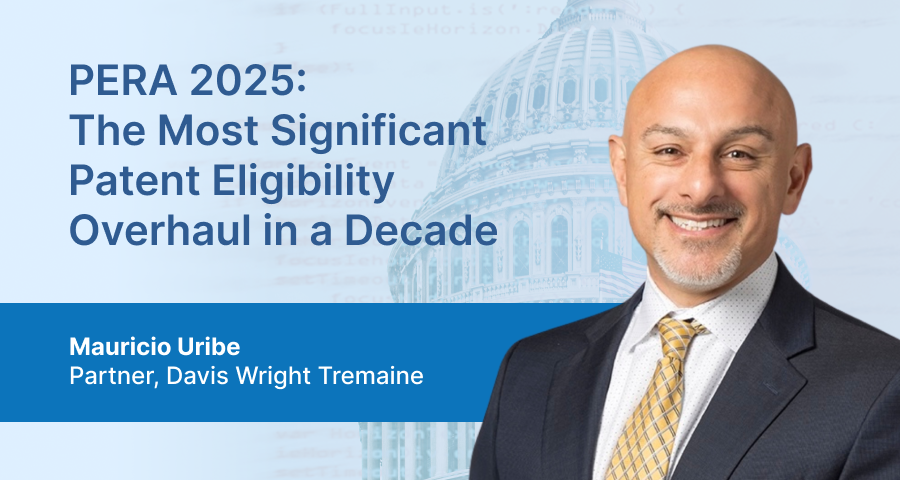
Here’s what you need to know before PERA reshapes the patent landscape. Read on for a deep dive from Mauricio Uribe, Partner at Davis Wright Tremaine, who outlines what legal teams can expect from pending changes.
By Mauricio Uribe, Davis Wright Tremaine
*The views expressed herein are those of the authors and don’t necessarily represent the views of LOT Network or any of its members
As Congress debates PERA 2025, stakeholders across the innovation economy face the prospect of a dramatically changed U.S. patent eligibility standard.
Few issues in U.S. patent law have generated more uncertainty—or more calls for reform—than the doctrine of patent subject matter eligibility. As courts, innovators, and investors continue to wrestle with the boundaries of what subject matter is considered patent eligible, Congress may be on the verge of a legislative effort that could redefine the contours of § 101 jurisprudence. Specifically, PERA 2025 (Patent Eligibility Restoration Act) is proposed U.S. legislation that aims to significantly modify US law related to patent subject-matter eligibility under 35 U.S.C. § 101. PERA 2025 is the third iteration of proposed US legislation related to changes in the definition of patent eligible subject matter and represents compromises from the two previous failed attempts at legislative reform.
Over the past decade, U.S. Supreme Court decisions (most notably the well-known Supreme Court decisions in Mayo, Alice, Myriad) and related Federal Circuit cases have clarified or expanded the long standing “judicial exceptions” to the statutory definition of what subject matter is eligible for patenting. The judicial exceptions to patent subject matter eligibility trace their historical basis to the Supreme Court’s 19th-century rulings—beginning with Le Roy v. Tatham (1852) and O’Reilly v. Morse (1853)—which held that fundamental principles, natural laws, and abstract ideas are the basic tools of scientific and technological work and therefore lie beyond the scope of patentable subject matter. As a judicially created doctrine, however, the result has been uncertainty and unpredictability across numerous intellectual property practice areas – rejected applications and prolonged patent prosecution, subject matter challenges in litigation, inefficiencies in licensing. The uncertainty and unpredictably hinge on whether inventions—especially in biotech, diagnostics, AI, software—are eligible for patenting.
Historically, uncertainty and unpredictability in judicial interpretation can be best addressed via statutory reform or clarification. PERA 2025 would entirely remove the judicially created subject-matter eligibility exceptions (as most recently defined by the two-part Alice/Mayo framework). In place, PERA 2025 would establish a much more inclusion definition of patent eligible subject matter limited by a finite set of statutory definitions of what subject matter is excluded. Specifically, under PERA 2025, the statutory exclusions would be limited to:
- A mathematical formula that is not part of a claimed invention.
- Processes that are substantially economic, financial, business, social, cultural or artistic in nature, even if they involve a machine etc.
- Mental processes performed solely in the human mind; or processes that occur in nature wholly independent of human activity.
- Unmodified human genes as they exist in the body.
- Unmodified natural materials as they exist in nature.
Under PERA 2025, applications that have been rejected under 35 U.S.C. § 101 during prosecution or issues patents that were vulnerable to validity challenges in litigation may become clearly protectable. Specifically, patent holders and patent challengers would no longer engage in the difficult process of defining abstract concepts and attempting to identify recited technical improvements to generic components. At a minimum, PERA 2025 represents an opportunity to better unify the application of patent subject matter eligibility criteria between the USPTO, U.S. district courts, and U.S appellate courts.
As of late-2025, PERA remains pending—it has not been enacted. Even if successfully passed, the language of the bill may still change. However, now may be a great opportunity to contact U.S counsel for:
- Monitoring Legislative Developments
- Reviewing Pending U.S. Applications / Prosecution Strategy
- Adjusting Existing Drafting Practices
- Evaluating Global Portfolio Strategies

Author: Mauricio Uribe, Partner, Davis Wright Tremaine
Mauricio Uribe is a strategic advisor with three decades of industry-recognized experience in intellectual property law, providing comprehensive counseling that spans patent prosecution, portfolio development, trade secrets protection, and enforcement for a diverse clientele, from individual inventors to Fortune 500 companies. Repeatedly named one of “The World’s Leading IP Strategists,” he develops patent and trademark portfolios across various sectors, including financial services, software, consumer electronics, automotive, and medical devices. As a trained computer and electrical engineer, he has deep technical knowledge in areas like AI/ML, virtualization, and distributed ledger technology, and is a frequent thought leader and lecturer on IP topics such as patent subject matter eligibility and licensing.