



In late January 2026, Shopify announced it had prevailed after a three year legal battle against a “patent troll” (or a patent assertion entity, PAE, as they are often called). They follow in the footsteps of companies like, Newegg, who became a heroic symbol to many in the startup community, aggressively facing down threats from patent assertion entities, refusing to settle, and prevailing in many cases in court. They even had an official “Don’t Settle” t-shirt. And, subreddits like t/technology, r/IAMA, and r/OutOfTheLoop were actively discussing Newegg’s proactive, aggressive, and successful stance. CloudFlare also stared down the PAEs, winning with much fanfare in 2017. These are three stellar, standout, notable legal and public relations battles the likes of which few companies have the will to take on.
The truth is, those who lose their battles are often out-capitalized, and nowhere is this more common than with startups. More common is the fate of companies like Mycroft AI, a promising startup that was the target of a PAE suit over AI voice commands (r/homeautomation). The legal ordeal scared away investors and drained Mycroft’s limited resources, eventually forcing leadership to cease operations.
Unfortunately, many of today’s startups don’t think about unmerited patent litigation, or PAEs at all. And, if they do, they believe that the risk, or PAE problem, is a thing of the past, or that it doesn’t apply to them because they don’t have few or no patents at all. Or they assume they will “fly under the radar,” and are too small to be sued. Or, worst case, they believe that if sued, they could reason with the PAE for a small settlement. This is a dangerously false set of assumptions.
The reality:
Fact: PAEs disproportionately target early-stage companies, with over 50% of litigation directed at businesses generating less than $25 million in annual revenue. Startups don’t even need to own patents, but can be targeted simply because they are using foundational technology from a third-party provider that is caught up in a wide-ranging PAE lawsuit. Defending against these lawsuits can cost startups millions and, in many cases, force them out of business.
Fact: The threats faced by companies such as Shopify, Newegg and Cloudflare and the cost of litigation when they were embroiled in defending their businesses are outlying success stories of individual companies that invested time, resources and energy into public battles and prevailed. Most startups taking on these entities alone don’t survive to tell the tale.
Fact: Today’s startups overlook new, modern, collective protective strategies that cost them nothing, and offer immunity against millions of potential claims. Non-profit LOT Network, with nearly 6K members ranging from tech giants to innovative startups is the most effective and preventative collective solution.
Fact: Startups that qualify—those earning less than $25 million annually—can become LOT Network members at no cost, gaining access to IP protection that includes nearly 6 million patent assets globally. And, they retain all traditional uses of patents, like selling them or using them to sue other companies – even other members, for infringement. More details on membership can be found here: learn more
Fact: Since founding, LOT Network has been a useful deterrent against patent assertion entity litigation, with public battles and widespread acuity leveling off over several years according to prominent voices in the community. But changes at the federal level threaten to upend this paradigm, with PAEs increasingly emboldened to take action, and in many cases, favored to win handily. Startups, with their limited budgets and defenses, are likely to be among early targets.
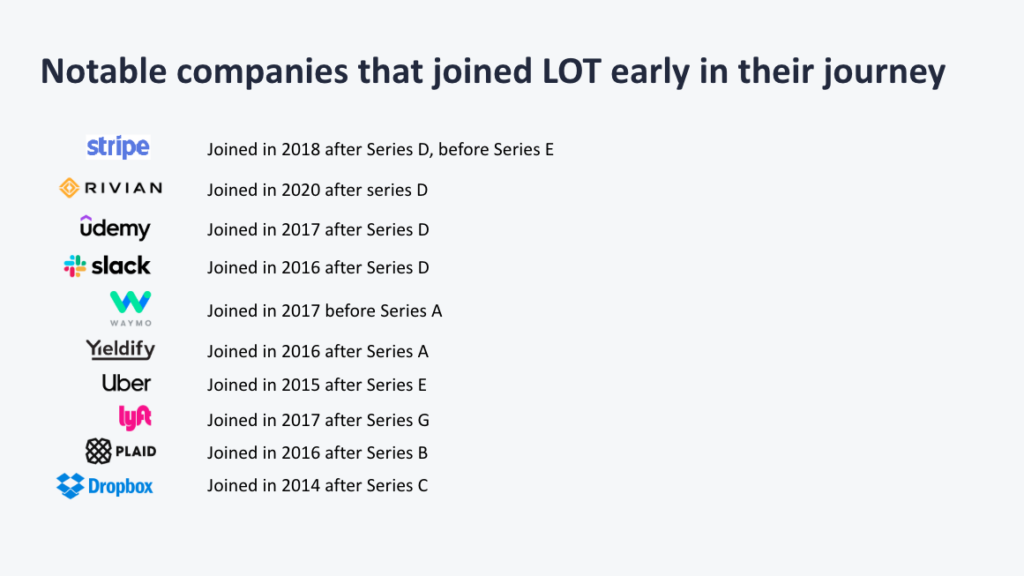
In this context, many of today’s most successful technology companies have made LOT part of their proactive IP strategy long before litigation ever became a threat.
What our members are saying:
Dropbox: “LOT solves a very real problem at a low cost. It doesn’t matter how big or small your company is, at some point you will be sued by a patent troll. It will be expensive and worse, cause a lot of interruption to the people at your company who are actually building something.” – Ramsey Homsany, General Counsel
Meta / Facebook & Asana: “Startups need to overcome many risks before they can become mature, thriving companies. The LOT Network is a powerful and creative new idea that will help ensure that patent abuse need not be one of them,” – Dustin Moskovitz, cofounder of Facebook & Asana, billionaire angel investor
Red Hat: “The thing to understand about NPEs is they are not about the merits of their invention, they are about negotiating leverage to maximize the money they get – that’s the game they are playing – and so, when you are a pre-IPO company, or you are a small company wishing to be privately acquired, you are in a vulnerable state. With the average cost to defend an NPE lawsuit hovering around $4 million, there is a clear benefit to taking protective measures, like joining a defensive community such as LOT Network, to reduce exposure,” – Patrick McBride, Assistant General Counsel
Uber: “This is a big-tent kind of program; it should appeal to all kinds of companies; it’s pretty much a no-brainer to join to provide peace of mind.” – Eric Schulman, Senior Director of Intellectual Property