



This content is provided as a benefit for our members and subscribers. The opinions expressed herein are those of the author and are not necessarily those of LOT Network or any of its members.
By Gene Lee, Jessica Kaiser, Christopher Marando, and Jon Carter, Partners at Perkins Coie
This is the second of three articles examining changes in policies and practices of the Patent Trial and Appeal Board (PTAB) of the U.S. Patent and Trademark Office (USPTO). The first article looked at changes under Acting Director Coke Morgan Stewart from the beginning of 2025 through October 2025. This article looks at additional changes since John Squires became Director in September 2025.
As discussed below, Director Squires has continued and expanded the discretionary denial practices that started under Acting Director Stewart. These changes undeniably make obtaining institution of inter partes reviews (IPRs) more challenging than under prior Directors. Nevertheless, data since Director Squires took control of institution decisions show that IPRs remain viable in some circumstances, including, for example, when (1) the Examiner made material errors during prosecution; or (2) the patent is less than six years old, there is not a prior unsuccessful validity challenge against the patent, and trial in any parallel litigation is unlikely to occur before the final written decision in the IPR.
Our final installment will discuss these circumstances in more detail and offer considerations for challenging a patent at the PTAB, including how to craft a petition to maximize the chances of institution. We will also address when to consider alternative approaches.
Director-controlled institution decisions as to both discretionary and merits/non-discretionary considerations
As noted in the first installment, when Coke Morgan Stewart was Acting Director, she determined whether a petition would be denied for discretionary reasons or referred to a panel of PTAB judges to decide whether to institute based on the merits/non-discretionary considerations. Her decisions typically took the form of a short written explanation of the reason(s) for either discretionarily denying or referring a given petition.
Since October 17, 2025, however, Director Squires no longer refers petitions to panels of PTAB judges. [1] Nor does the Director provide reasoning for his institution decisions absent special circumstances. Rather, for any given petition, he issues a first summary notice stating whether the petition will be discretionarily denied or reviewed for merits/non-discretionary considerations. If not denied for discretionary reasons, the Director subsequently issues a second summary notice stating whether the petition is granted or denied institution.
As of the end of January 2026, the Director has issued summary notices deciding whether to discretionarily deny more than three hundred petitions, but he has issued only four opinions with reasoning for his decisions:
- Ford Motor Co. v. AutoConnect Holdings LLC, IPR2025-01342, -01383, Paper 10 (Dec. 4, 2025) (declining to discretionarily deny petitions where the prior patent owner was the petitioner’s supplier and, therefore, the petitioner had “a well-settled expectation” that it would not be accused of infringement; also noting that the patent owner allowed one of the patents to lapse by failing to timely pay maintenance fees).
- Caption Health, Inc. v. The Univ. of British Columbia, IPR2025-01422, Paper 15 (Dec. 18, 2025) (“Under Revvo, a petitioner must explain any inconsistent claim construction positions. While it is not entirely clear whether Petitioner sought to advance an inconsistent claim construction position in this proceeding, the Office accepts Petitioner’s ‘consent’ as a stipulation to construe ‘quality assessment value’ herein—[]and in any other proceeding before the Office that involves Petitioner and the same claim term—as ‘score of diagnostic image quality,’ as Petitioner proposed in district court. Petitioner’s stipulation, therefore, resolves any potential inconsistency in claim construction positions between forums and does not require further explanation under Revvo.”).[2]
- Top Glory Trading Grp. Inc. v. Cole Haan LLC, IPR2025-01395, Paper 18 (Jan. 12, 2026) (designated informative: Jan. 12, 2026) (declining to discretionarily deny petition notwithstanding the patent owner’s “settled expectations” where there was a significant change in design patent law).
- TikTok, Inc. v. Shopsee, Inc., IPR2025-01485, Paper 13 (Jan. 16, 2026) (discretionarily denying petition where the petitioner “stipulated that it will continue to pursue different constructions” in district court and the IPR “and abandon the inconsistent construction in district court if the IPR is instituted”).
Discretionary denial considerations under Director Squires
The October 17, 2025 memo announcing that Director Squires would issue all Institution Decisions further stated: “The Office has issued more than 580 decisions under the Interim Processes, providing substantial guidance on how the Director will handle discretionary considerations.” [3] Thus, Acting Director Stewart’s prior treatment of discretionary considerations continues to be relevant under Director Squires. In practice, this means that the following exemplary discretionary considerations continue to inform the analysis:
- Errors during prosecution: If a petitioner can demonstrate that the USPTO committed a material error during prosecution, this may outweigh other discretionary considerations supporting denial.
- Complex litigation: If a patent is involved in complex parallel litigation, this may outweigh other discretionary considerations supporting denial.
- Presumptive (but potentially rebuttable) “settled expectations” for patents in force six or more years: Petitions challenging patents that have been in force six or more years are typically denied absent countervailing facts such as a material error during prosecution or complex litigation.
- Parallel litigation: If a patent is being litigated in another forum—either district court or the International Trade Commission (ITC)—and it is likely that validity will be decided in that forum before the PTAB would issue a final written decision, the Director is unlikely to institute the petition. This creates a heavy presumption in favor of discretionary denial unless the petitioner can present a compelling reason—such as a material error during prosecution—that justifies institution.
- Ex parte reexaminations: If a patent is subject to an earlier-filed ex parte reexamination, this favors discretionary denial, particularly if the ex parte reexamination is at an advanced stage.
- Stipulations: To pursue an IPR, petitioners generally must make a broad stipulation to forgo validity challenges in other forums. Under prior practice (i.e., before Acting Director Stewart’s procedural changes in early 2025), when trial in the parallel litigation was likely to come before the final written decision in the IPR, petitioners often filed a so-called Sotera [4] stipulation to forgo pursuing in the parallel litigation the same grounds presented in the IPR or any grounds that could have reasonably been raised before the PTAB. Such stipulations are now essentially mandatory, even if no parallel case is pending. Petitioners might also consider broader stipulations that further stipulate not to pursue the following in a parallel litigation:
- Petition art with unpublished system art;
- Any system art embodied by prior art that could have been raised in IPR; or
- Any §§ 102 or 103 arguments.
- Previous invalidity challenge: If a patent has survived a challenge in any forum (e.g., a prior PTAB trial, district court, or even an ex parte reexamination), the Director is inclined to discretionarily deny the petition. This is foreshadowed in the Notice of Proposed Rulemaking (NPRM) discussed below, which states that the PTAB will focus on patents “that have not previously been challenged in litigation.” [5]
Precedential and informative decisions under Director Squires
Under Director Squires, the USPTO has designated a significant number of decisions as precedential and informative. [6] These decisions address various issues and are summarized below. Although they provide guideposts, it remains unclear how Director Squires will apply them in cases going forward.
1. A petitioner’s need to explain why a petition is an appropriate use of USPTO resources and various circumstances affecting the parties’ “settled expectations”
- Dabico Airport Sols. Inc. v. AXA Power ApS, IPR2025-00408, Paper 21 (June 18, 2025) (designated informative: Jan. 9, 2026) (discretionarily denying petition based on patent owner’s settled expectations and the petitioner’s failure to provide persuasive reasoning explaining why IPR is appropriate use of USPTO resources).
- Amgen Inc. v. Bristol-Myers Squibb Co., IPR2025-00601, -00602, -00603, Paper 9 (July 24, 2025) (designated informative: Jan. 9, 2026) (explaining that a patent owner may have settled expectations in a patent in force for three years, although the patent owner had not articulated sufficient reasons in these proceedings).
- Home Depot U.S.A., Inc. v. H2 Intellect LLC, IPR2025-00480, Paper 11 (Sep. 4, 2025) (designated informative: Jan. 9, 2026) (declining to discretionarily deny a petition challenging a patent in force over six years where “the challenged patent has not been commercialized, asserted, marked, licensed, or otherwise applied in its technology space”).
- Apple Inc. v. Ferid Allani, IPR2025-00856, Paper 11 (Sep. 5, 2025) (designated informative: Jan. 9, 2026) (declining to discretionarily deny a petition where the petitioner expected that the challenged patent would not be asserted against it after the petitioner advised the patent owner that it did not require a license and the patent owner waited to assert the patent until eleven years later and after it had expired).
- Alliance Laundry Sys., LLC v. PayRange LLC, IPR2025-00950, Paper 11 (Sep. 19, 2025) (designated informative: Jan. 9, 2026) (discretionarily denying a petition challenging a patent that was in force less than six years where the patent owner presented evidence of licensing, creating some evidence of settled expectations; also noting that previous petitions challenging the patent were denied on the merits and the petitioner correcting the deficiencies raised concerns of road mapping).
2. Material error during prosecution and complex litigation as factors weighing against discretionary denial
- Padagis US LLC v. Neurelis, Inc., IPR2025-00464, -00465, -00466, Paper 12 (July 16, 2025) (designated informative: Jan. 9, 2026) (declining to discretionarily deny petition where there was an apparent material error by the USPTO during examination).
- Tesla, Inc. v. Intellectual Ventures II LLC, IPR2025-00217, Paper 9 (June 13, 2025) (designated informative: Jan. 9, 2026) (declining to discretionarily deny petition and explaining that the “large number and vast scope of the patents asserted in the district court litigation…weighs against discretionary denial, as the Board is better suited to review a large number of patents involving diverse subject matter”).
3. Increased scrutiny on a petitioner who takes different claim construction positions in parallel litigation and before the PTAB
- Revvo Techs., Inc. v. Cerebrum Sensor Techs., Inc., IPR2025-00632, Paper 20 (Nov. 3, 2025) (designated precedential: Nov. 3, 2025) (stating that a petitioner should explain sufficiently why different claim construction positions in the petition and in another forum are warranted).
- The precedential Revvo decision provided the following example of a sufficient explanation: “if a party advances a narrow construction in the district court and the district court declines to adopt the narrow construction, the party would have sufficient reason for advancing the broader, court-adopted construction in a proceeding before the Board.” Id. at 5 (quotations omitted).
- In a subsequent decision, the Director clarified that “in the generally rare instances where diverging constructions are advanced before two different tribunals, a party may proffer a different, broader construction before the Board when the district court already has rejected petitioner’s narrower construction.” Id., Paper 36 at 4 (Jan. 26, 2026) (italics in original).
- Tesla, Inc. v. Intellectual Ventures II LLC, IPR2025-00340, Paper 18 (November 5, 2025) (designated informative: Nov. 5, 2025) (explaining that a petitioner who argues indefiniteness in district court must provide a sufficient explanation regarding why a different claim construction position in IPR is warranted).
- Sun Pharm. Indus., Inc. v. Nivagen Pharm., Inc., IPR2025-00893, Paper 18 (Sep. 19, 2025) (designated informative: Jan. 9, 2026) (discretionarily denying petition where the petitioner took a narrower claim construction position in district court and failed to explain why a broader construction in IPR was warranted).
4. More limited circumstances when joinder and parallel petitions will be instituted
- Elong Int’l USA Inc. v. Feit Elec. Co., IPR2025-00258, Paper 16 (June 25, 2025) (designated precedential: Jan. 9, 2026) (explaining that, for copycat petitions requesting joinder to a pending petition, discretionary considerations are first reviewed for a petition as if joinder were not sought and then reviewed as if joinder were to be granted).
- Realtek Semiconductor Corp. v. ParkerVision, Inc., IPR2025-00324, Paper 11 (June 25, 2025) (designated precedential: Jan. 9, 2026) (explaining that joinder petitions filed by time-barred parties should proceed only in exceptional circumstances).
- PacifiCorp v. Birchtech Corp., IPR2025-00687, -00688, -00717, -00718, Paper 40 (Jan. 12, 2026) (designated precedential: Jan. 12, 2026) (vacating institution of parallel petitions based on different priority dates and remanding to the Board to institute no more than one petition per challenged patent).
5. The administration favors post-grant reviews (PGRs)
- LifeVac LLC v. DCSTAR Inc., IPR2025-00454, Paper 11 (July 11, 2025) (designated precedential: Jan. 9, 2026) (explaining that IPRs “will generally not be discretionarily denied because of an earlier petition for post-grant review when the post-grant review was not instituted”).
- Multi-Color Corp. v. Brook & Whittle Ltd., PGR2025-00025, Paper 10 (July 16, 2025) (designated precedential: Jan. 9, 2026) (explaining that “[p]etitions for post-grant review are favored because they must be filed no later than nine months from the grant of the patent…, are close in time to examination, and occur before expectations in the patent rights are strongly settled”).
6. A patent owner asserting new claims in parallel litigation weighs against discretionary denial of a subsequent petition challenging those newly asserted claims
- Savant Techs. LLC d/b/a GE Lighting v. Feit Elec. Co., Inc., IPR2025-00260, Paper 16 (June 12, 2025) (designated informative: Jan. 9, 2026) (declining to discretionarily deny institution of a second petition when the patent owner asserted additional claims in district court after a previously filed IPR).
7. A change in law weighs against discretionary denial
- Top Glory Trading Grp. Inc. v. Cole Haan LLC, IPR2025-01395, Paper 18 (Jan. 12, 2026) (designated informative: Jan. 12, 2026) (discussed above).
8. Stricter enforcement of requirement to identify all of the Real Parties in Interest (RPIs)
- Corning Optical Commc’ns RF, LLC v. PPC Broadband, Inc. (except § II.E.1), IPR2014-00440, Paper 68 (Aug. 18, 2015) (designated precedential: Oct. 28, 2025) (addressing RPI issues, with the practical result being that if a petition fails to name all RPIs, the petition will be dismissed and the petitioner must refile).
- Yangtze Memory Techs. Co. v. Micron Tech., Inc., IPR2025-00098, Paper 38 (Jan. 15, 2026) (designated informative: Jan. 16, 2026) (vacating and denying institution where a petitioner had not provided sufficient argument and evidence for the USPTO to determine whether the petitioner identified all RPIs).
Search disclosure declarations
On November 17, 2025, Director Squires issued a memorandum titled “Voluntary Search Disclosure Declarations as Favorable Factor in Institution Decisions”[7] stating that a petitioner may submit a search disclosure declaration with its petition that provides detailed information regarding how the petitioner located the prior art presented in the petition. Such a submission “will be considered as a non-exclusive, non-dispositive favorable discretionary factor supporting institution.” [8] However, a petitioner who does not submit a search disclosure declaration “will not be disadvantaged.” [9] It is presently unclear what effect such submissions will have on discretionary denial outcomes in practice.
Notice of proposed rulemaking (NPRM)
The USPTO issued an NPRM on October 17, 2025, proposing to revise PTAB rules to make certain discretionary bars binding, including: (1) mandatory stipulations that IPR petitioners will not to pursue validity challenges under 35 U.S.C. §§ 102 or 103 in other forums; (2) no institution of an IPR for challenged claims found not invalid under §§ 102 or 103 in other proceedings; and (3) no institution of an IPR if it is more likely than not that any of the following will occur regarding the challenged claims before the final written decision: (a) a district court trial, (b) an ITC initial/final determination, or (c) a final written decision in another PTAB proceeding addressing §§ 102 or 103 invalidity.[10] The proposed rules further allow sanctions for “frivolous” or “abusive” petitions that try to invoke nonexistent “extraordinary circumstances” to avoid these bars.
The USPTO received more than 11,000 comments to the October 17th proposal, reflecting significant public engagement. [11] Many tech companies, industry coalitions, and patent attorneys argued that the rules go too far and may exceed the Director’s statutory authority, while patent owner groups and certain lawmakers submitted comments in strong support, praising the increase in patent certainty.
The USPTO scheduled a webinar regarding the rules for December 2025, but the webinar was postponed until 2026. [12] As of January 2026, the webinar has not been rescheduled, and the rules have not been implemented.
Petition filings under Director Squires
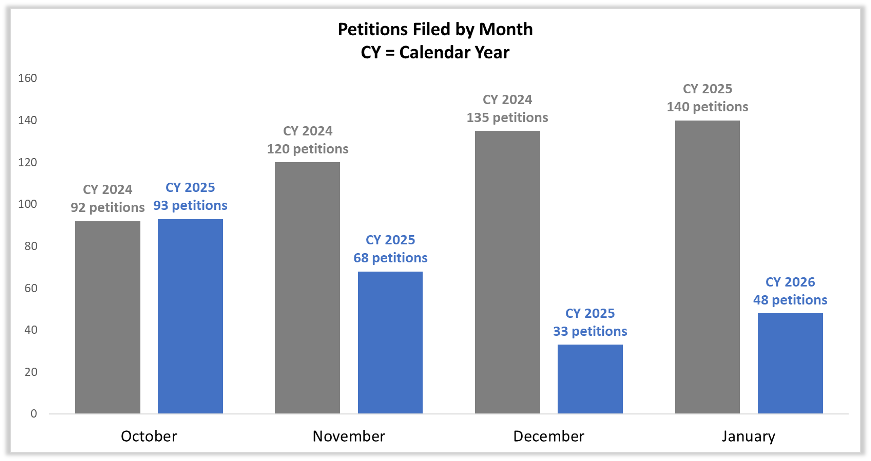
The discretionary denial practices under Acting Director Stewart and Director Squires have led to a significant drop in petition filings in recent months. For example, in December 2024, petitioners filed 135 petitions (129 IPRs and 6 PGRs). In December 2025, petitioners filed only 33 petitions (30 IPRs and 3 PGRs)—an approximately 76% decrease. Filings in January 2026 rebounded slightly to 48 petitions (46 IPRs and 2 PGRs), but they were still down approximately 66% compared to January 2025, when petitioners filed 140 petitions (131 IPRs and 9 PGRs).[13]
Institution rates under Director Squires
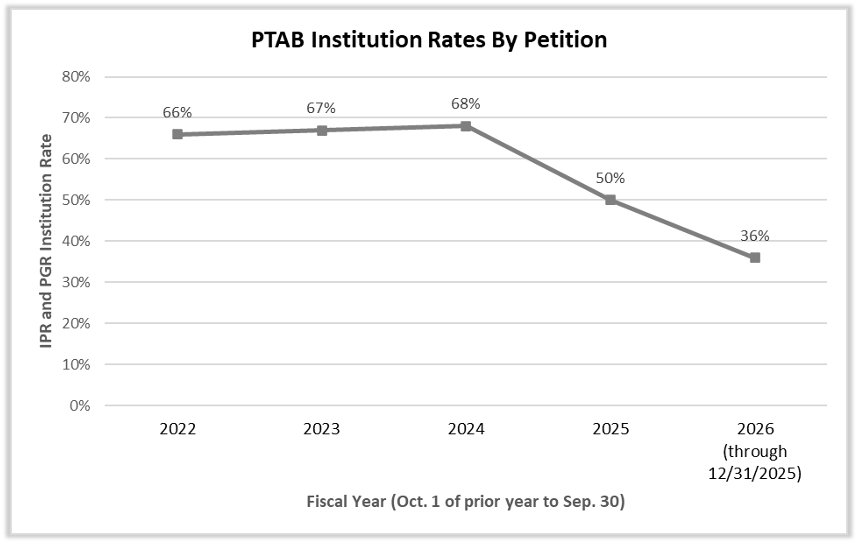
Historically, the PTAB granted roughly 60-70% of petitions on average, with some fluctuation over time. In fiscal year 2025 (Oct. 1, 2024 through Sep. 30, 2025) and fiscal year 2026 (Oct. 1, 2025 to present), the discretionary denial practices under Acting Director Stewart and Director Squires have significantly reduced institution rates. From October to December 2025, for example, the USPTO instituted only 36% of petitions (illustrated below). [14] This includes both petitions addressed in summary notices and petitions addressed under the previous bifurcated procedure.
Focusing on petitions addressed in Director Squires’ summary notices, as of December 31, 2025, approximately 58% of petitions (both IPRs and PGRs) were discretionarily denied and approximately 42% were referred for consideration of the merits/non-discretionary considerations. Of the referred petitions, approximately 78% were instituted. Overall, the projected institution rate was approximately 33%. [15]
This reduction in the institution rate is likely the result of not only the discretionary denial practices themselves, but also the fact that many petitions decided during this period were filed before the USPTO provided guidance regarding application of the discretionary factors. Moving forward, petitioners should calibrate their filing strategies in view of the current discretionary denial practices, which we will address in more detail in the next installment.
- [1] https://www.uspto.gov/sites/default/files/documents/open-letter-and-memo_20251017.pdf
- [2] Perkins Coie is counsel to the University of British Columbia in this action.
- [3] Id.
- [4] Sotera Wireless, Inc. v. Masimo Corp., IPR2020-01019, Paper 12 (Dec. 1, 2020) (precedential as to § II.A)
- [5] https://www.federalregister.gov/documents/2025/10/17/2025-19580/revision-to-rules-of-practice-before-the-patent-trial-and-appeal-board
- [6] https://www.uspto.gov/patents/ptab/precedential-informative-decisions
- [7] https://www.uspto.gov/sites/default/files/documents/vsdd_as_a_favorable_factor_in_institution_decisions.pdf
- [8] Id.
- [9] Id.
- [10] https://www.federalregister.gov/documents/2025/10/17/2025-19580/revision-to-rules-of-practice-before-the-patent-trial-and-appeal-board
- [11] https://www.unifiedpatents.com/insights/2025/12/17/the-public-has-spoken-again; https://www.regulations.gov/docket/PTO-P-2025-0025
- [12] https://content.govdelivery.com/accounts/USPTO/bulletins/400065a
- [13] The USPTO has published petition filings through calendar year November 2025. https://www.uspto.gov/sites/default/files/documents/Trial_Stats_November_2025.pdf. The authors compiled the petition filings for December 2025 and January 2026.
- [14] The USPTO statistics for FY 2022 through 2025 were published by the USPTO. https://www.uspto.gov/sites/default/files/documents/Trial_Stats_November_2025.pdf. The authors compiled the statistics for FY2026 through December 31, 2025.
- [15] The authors compiled the Summary Notice statistics. The projected institution rate was calculated by multiplying the 42% referral rate by the 78% institution rate.