




This content is provided as a benefit for our members and subscribers. The opinions expressed herein are those of the author and are not necessarily those of LOT Network or any of its members.
By Gene Lee, Jessica Kaiser, Christopher Marando, and Jon Carter, Partners at Perkins Coie
This is the last of three articles examining recent changes in policies and practices of the U.S. Patent and Trademark Office (USPTO) Patent Trial and Appeal Board (PTAB). Our first article looked at changes under Acting Director Coke Morgan Stewart from the beginning of 2025 through October 2025. The second article discussed additional changes under Director John Squires, starting from his confirmation in September 2025 to mid-February 2026. This final article picks up where the second article ended by addressing important substantive and procedural updates in PTAB practice since February 2026, including the latest statistics, new discretion considerations, and recent key decisions from the Director. [1] In addition, we briefly discuss considerations for pursuing an ex parte reexamination as an alternative to an IPR in cases where discretionary denial is likely under the current framework.
I. Recent data from the PTAB confirm lower numbers of new petitions and an increase in discretionary denials
After our last article, the PTAB released official trial statistics from March 2025 through March 2026,[2] and those statistics confirm that new IPR and PGR petition filings have dropped precipitously over the last year—from a high of 135 petitions in May 2025 to fewer than 50 petitions per month thus far in 2026. In April 2026, only 15 IPR and five PGR petitions were filed.

Data since Director Squires took control of institution decisions in October 2025 show that the discretionary denial rate (under 35 U.S.C. §314 and §325(d))—as opposed to denial on the merits—is primarily responsible for the reduced rate of PGR/IPR institutions. Through May 15, 2026, the Director discretionarily denied 61% of all petitions (IPRs and PGRs combined), whereas the institution rate for petitions that the Director did not discretionarily deny and that were subsequently considered on the merits remains high at approximately 68% (illustrated below).[3]
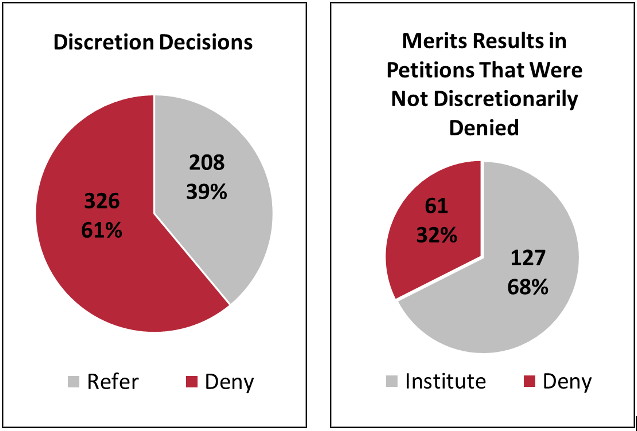
IPRs thus remain a viable tool where the related facts weigh against discretionary denial under the Director’s criteria—e.g., where the challenged patent is less than six years old, its validity has not been previously adjudicated, and the Board is likely to issue a final written decision before trial in a co-pending litigation.
II. New discretionary denial considerations
On March 11, 2026, Director Squires issued another memorandum outlining “Additional Discretionary Institution Considerations.”[4] According to that memo, “many of the most frequent users of IPR and PGR proceedings are large companies that have stated in public financial disclosures that they do not have a significant, existing manufacturing presence in the United States, nor are they taking concrete steps to invest in American manufacturing.” The Director therefore encouraged parties to identify “relevant facts” regarding the “extent to which AIA proceedings give a tactical advantage to companies that neither manufacture in the United States, nor are making American manufacturing investment.” And the Director further encouraged small businesses that have been sued for infringement to identify themselves. Accordingly, the Director’s latest memo identified three additional factors at the discretionary denial stage of PTAB proceedings:
- The extent to which any products accused of infringement in a parallel proceeding are manufactured in the United States or are related to investments in American manufacturing operations
- The extent to which any products made, sold, or licensed by the patent owner that compete with the accused products are manufactured in the United States
- Whether the petitioner is a small business that has been sued for infringement of the patent at issue
To date, Director Squires has not issued a discretionary opinion specifically addressing these newest considerations, so their impact remains to be seen.
III. Recent noteworthy decisions from the Director
Since our last article published in February 2026, the Director has designated additional decisions as “Precedential” and “Informative,” and the Director has also issued several opinions with reasoning. For example, in the Magnolia Medical Techs., Inc. v. Kurin, Inc. precedential decision discussed below, the Director collected and restated principles from several prior decisions and memorandums, explaining the current standard for exercising discretion to deny a petition and the Director’s view of the Congressional intent for AIA reviews. The Magnolia Medical decision also emphasized the Director’s significant discretion in executing AIA reviews and highlighted Director Squires’ view that AIA reviews should serve a public interest function and are not solely about resolving private disputes.
As summarized below, the Director’s recent “Precedential” and “Informative” decisions closely consider certain issues at the discretionary stage, including public interest, examiner error, whether the petitioner is advancing different claim constructions in different forums, real parties in interest (RPI) to the petitioner, whether the petitioner or its RPI is a foreign sovereign, and settled expectations. The decisions also highlight that the Director expects petitioners to adhere to stipulations to forego prior art challenges in parallel proceedings—and will vacate institution if a petitioner violates its stipulation.
- Magnolia Medical Techs., Inc. v. Kurin, Inc., IPR2026-00097, Paper 17 (May 14, 2026) (precedential)
-
- In Magnolia Medical Techs., the Director discretionarily denied a petition where a jury had determined the challenged patent was not invalid. Notably, the petitioner’s expert had been precluded from presenting testimony on anticipation and obviousness due to a failure to disclose the claim construction upon which the opinions were based. The Director stated that the failure to disclose the claim construction was within the petitioner’s control and, although the petitioner’s expert had not testified regarding anticipation/obviousness issues, the petitioner “had the opportunity to fully and fairly litigate these issues before the district court, did so, and lost ….” Thus, the petitioner was “attempting to use the Office as a repeat challenge or second bite at the apple to undo its litigation loss. This is difficult to square with Congress’s intent and why it vested broad discretion in the Director to deny institution.”
-
- Separate from the facts of the IPR, the Director also discussed several policy issues.
-
-
- Legislative record. According to Director Squires, “[t]he purpose of AIA reviews was, and is, to provide a quick and cost effective alternative to district court patent litigation for resolving disputes over patent validity.” However, “many petitioners do not avail themselves of AIA review as an ‘alternative’ to litigation. Rather, many petitioners seek AIA review in parallel with litigation to gain leverage.” The Director noted that often parallel proceedings involve the same arguments or system art that overlaps with those arguments. Further, “[e]ven when the prior art and arguments” are “substantially different,” “AIA review often simply serves as a means by which the petitioner presents additional invalidity arguments under sections 102 and 103.”
-
-
-
- Misuse of AIA review. Director Squires cited instances where parties have filed multiple petitions without a sound reason and have filed petitions “after patents have been challenged unsuccessfully” in another forum or before the Office. The Director also noted that parties take inconsistent positions in different forums, “suggesting that parties are misleading one tribunal or the other or pursuing alternative theories under a ‘wait and see’ approach presumably to gain a litigation advantage and/or settlement leverage.”
-
-
-
- Not the province of small, U.S.-based manufacturers. Director Squires stated that “a handful of market dominant companies have filed most petitions for AIA review,” and “companies associated with foreign governments have been among the top ten AIA review petitioners (when considered collectively) while, at the same time, the U.S. government is not permitted to file AIA petitions.” For this reason, the Tianma decision (discussed below) “explains that, like the U.S. government, a party may not file an AIA review if the party or any of its real parties in interest (‘RPI’) is a foreign sovereign.”
-
-
-
- AIA reviews relate to the public interest. Director Squires explained that “[u]nlike court proceedings, AIA reviews are not solely about resolving a ‘private dispute’”; rather, “[t]he Office institutes review to reconsider its own decision and correct a possible error in the original patent grant—not to shield a particular petitioner from infringement liability.” “[C]ourts are, and always have been, the primary forum for adjudicating private disputes.” The Director explained that, in promulgating rules, Congress requires the Director to consider factors that “sound in the public interest,” “includ[ing] the economy, efficient administration of the Office, the ability of the Office to timely complete its AIA reviews, and the integrity of the patent system.” The Director further noted that “private litigants retain the right to challenge a patent on any ground in district court and lose no substantive rights when an AIA review is denied institution.”
-
-
-
- Director discretion should consider public interest. According to Director Squires, “Congress afforded significant discretion to the Director in duly executing the purposes of the AIA,” and “[a]t bottom, the central purpose of IPRs is to determine whether the patent at issue may have been improvidently granted and whether and to what extent that right should continue to be recognized at all. This is the very reason Congress conferred on the USPTO—rather than Article III courts—institution discretion, management of AIA proceedings, and AIA final decision-making. In short, discretion is afforded to ensure fairness, efficiency, and predictability in patent disputes in a focused inter partes context—as Congress envisioned—as distinct from the broad adjudication of private disputes in district court litigation. Our AIA review under Article I is ultimately regulatory; proceedings under Article III are adjudicatory.”
-
-
- Finally, Director Squires said “the Office has issued, and will continue to issue, guidance as to what, specifically, the public interest entails.” As an example, the Director referred to the U.S. Manufacturing Memorandum discussed in this article and stated that “[t]his will facilitate Office analysis as to whether AIA reviews provide a tactical advantage to companies that neither manufacture in the United States nor make American manufacturing investments.”[5]
- Claim-construction issues
-
- In Terumo BCT v. Haemonetics Corp., IPR2025-01374 et al., Paper 20 (May 12, 2026) (informative), Director Squires vacated notices granting institution and denied institution. The petitions stated that the claims “need no construction.” One week after institution, however, the petitioner argued in district court invalidity contentions that certain claims of each challenged patent were means-plus-function and indefinite. The Director stated that the “[p]etitioner knew that, consistent with Board precedent, it cannot take different positions on claim construction in the district court and at the Board without an adequate explanation.”
-
- In Ford Motor Co. v. Autoconnect Holdings, LLC, IPR2025-01342 et al., Paper 27 (May 12, 2026) (informative), Director Squires vacated notices granting institution and denied institution. The petitions advanced plain and ordinary meaning constructions. In parallel proceedings, the petitioner subsequently argued that all challenged claims were indefinite. The Director also determined that the petitioner’s stipulation to withdraw indefiniteness arguments if the Board agreed to maintain and not vacate institution of the IPRs was insufficient.
-
- In Infineon Techs. Americas Corp. v. Mosaid Tech. Inc., IPR2025-01456, Paper 27 (Mar. 17, 2026), Director Squires discretionarily denied Infineon’s petition for providing claim constructions that were inconsistent with those that Infineon proposed in the parallel district court proceeding and failing to explain why alternative positions were warranted.
-
- In Infineon Techs. Americas Corp. v. Mosaid Tech. Inc., IPR2025-01487, Paper 27 (Mar. 17, 2026), by contrast, Director Squires instituted an IPR despite Infineon taking inconsistent claim construction positions in the petition and in the parallel district court proceeding without explanation. Those inconsistent constructions only affected three dependent claims out of 21 challenged claims.[6]
- RPI issues
-
- In Tianma Microelectronics Co. v. LG Display Co., IPR2025-01579, Paper 12 (Mar. 18, 2026) (precedential), Director Squires discretionarily denied institution of Tianma Microelectronics’ IPR petition for failure to provide sufficient evidence to rebut the patent owner’s allegation that a foreign government was a real party in interest to the petition. That denial was, in turn, based on the Director’s finding that the U.S. Supreme Court decision in Return Mail, Inc. v. United States Postal Service, 587 U.S. 618 (2019), bars a foreign government from being a petitioner or its RPI in an AIA proceeding.
-
- In Curium US LLC v. Universität Heidelberg, IPR2025-01582, Paper 11 (February 25, 2026) (informative), Director Squires accorded Curium’s IPR petition a new filing date of January 5, 2026—after the Board had previously issued a Notice of Filing Date Accorded on October 3, 2025—following the petitioner’s amendment of mandatory notices to identify new RPIs. The petition was not time-barred under §315(b) based on the new filing date. The takeaway for petitioners is that any change to the real parties in interest after filing will result in a new filing date that resets the clock in the proceeding. This could be problematic for petitioners if the trial timing in a parallel proceeding will now be in advance of the anticipated final written decision—and catastrophic if the new petition filing date is after the §315(b) statutory bar date.
- Prior art stipulations: Enforcement, timing, and scope
-
- In Advanced Micro Devices, Inc. v. XtreamEdge, Inc., IPR2025-00223 et al., Paper 29 (May 12, 2026), Director Squires vacated and terminated IPRs where the petitioner “expressly incorporated the same art and same arguments from its petitions into its invalidity contentions after” the IPRs were instituted. Prior to institution, the petitioner had submitted Sotera stipulations in the IPRs.
-
- In Samsung Elecs. Co. v. Wilus Institute of Standards & Tech. Inc., IPR2025-00933 et al., Paper 23 (May 12, 2026), Director Squires denied a patent owner’s request for Director Review where the petitioner served invalidity contentions after filing IPRs—but before institution—that included prior art arguments the petitioner had stipulated not to pursue if the IPRs were instituted. The Director agreed with the petitioner that the “stipulation did not take effect until the Board instituted these IPRs….”
-
- In Samsung Elecs. Co. v. Netlist, Inc., IPR2026-00018, PGR2026-00001, Paper 20 (Apr. 28, 2026), Director Squires denied institution of a challenged patent subject to an ITC investigation in which the final initial determination would issue before the final written decision in the IPR. The Director determined that the petitioner’s stipulation in the ITC—i.e., not to pursue invalidity defenses based on grounds that reasonably could have been raised in the petitions, or any ground based on a combination of system prior art and the petition references—was untimely because it was not filed until after the patent owner’s request for discretionary denial. The Director also determined that the stipulation was ineffective because it did not bind the petitioner’s co-respondents.
- Failure to disclose commonly assigned prior art
-
- In Microsoft Corp. v. Sandpiper CDN, LLC, IPR2026-00180, Paper 15 (May 6, 2026), [7] Director Squires declined to discretionarily deny a petition that relied upon a reference that was commonly assigned but not before the Office during prosecution. The Director stated that “Patent Owner’s failure to cite a commonly assigned reference to the Office is relevant to the holistic analysis for considering discretionary denial. The Office has a commitment to issuing reliable and durable patent rights resulting from high-quality examination. A patent applicant’s failure to provide prior art that it owns cuts against its settled expectations and weighs against discretionary denial.”
IV. Ex parte reexaminations (EPRs): An alternative to IPRs?
In instances where discretionary factors (e.g., patent age, trial date relative to FWD, prior unsuccessful challenges) are likely to lead to denial of an IPR/PGR petition, would-be patent challengers might consider whether an EPR is a desirable alternative.
A. EPRs vs. IPRs/PGRs
Anyone may request an EPR, even the patent owner, and it is handled by the Central Reexamination Unit (CRU) of the USPTO, rather than the PTAB. Unlike IPRs and PGRs, EPR requests are not subject to a word limit and have a significantly lower filing fee ($13,545 for a non-streamlined request for a non-small/micro entity) than IPRs and PGRs.[8] The CRU determines whether an EPR request presents a substantial new question (SNQ) of patentability within three months of filing.[9] In so doing, the CRU applies the “broadest reasonable interpretation” (BRI) standard to construe the claims, unlike in IPRs and PGRs, where the PTAB applies the same Phillips standard that is used in district courts. Obviousness-type double patenting arguments can also be presented in EPRs, whereas these arguments are not available in IPRs and PGRs.
Notably, unlike IPRs and PGRs, discretionary considerations under §314 do not apply to EPRs, but §325(d) considerations do apply to EPRs in the same way that they apply to IPRs and PGRs. Furthermore, a recent decision from the CRU indicates that it may begin to use §325(d) to deny EPRs that present the same arguments as discretionarily denied IPR petitions. In EPR No. 90/015,984, the CRU denied the request for reexamination under §325(d) because the requester had previously challenged the same patent on the same invalidity grounds in an IPR that Acting Director Stewart had discretionarily denied based on settled expectations (patent age and actual notice)—meaning that the Office never previously evaluated the merits of the invalidity grounds, but the CRU denied the EPR request anyway.[10]
If the CRU finds a SNQ of patentability and orders reexamination, the patent owner may file a statement concerning the determination of an SNQ. If the patent owner files such a statement, the requester may file a reply. For this reason, patent owners rarely file such a statement. If the patent owner does not file such a statement, reexamination proceeds without further involvement from the requester—including opportunities for the patent owner to conduct ex parte interviews with the examiner and amend claims. This presents significant advantages for patent owners in comparison to IPR and PGR proceedings (in which the petitioner remains involved during the entire process). Unlike IPRs and PGRs, however, there is no statutory estoppel for unsuccessful EPR challenges. Also, unlike IPRs and PGRs, there is no statutory deadline for an EPR to conclude.
B. New procedure for patent owners to provide information before an SNQ determination in EPRs
On April 1, 2026, Director Squires issued a new procedure for EPR proceedings that allows patent owners the option of filing a “pre-order paper” of up to 30 pages “to provide information on why an argued teaching(s) in a request for reexamination would not raise a substantial new question of patentability.”[11] This is akin to the Patent Owner’s Preliminary Response in IPR/PGR proceedings. If the patent owner files a pre-order argument in an EPR proceeding, the requester may not ordinarily respond. However, if the requestor believes that the patent owner’s paper contains misrepresentations of fact or law or other improper arguments that materially impede the determination of an SNQ, the requester may file a petition to be granted an exception. If the exception is granted, the requester may file a responsive paper to address the alleged misrepresentations or improper arguments. Such a responsive paper must be filed with a grantable petition.
C. EPR statistics
Historical data from the USPTO show that very few EPRs (~14.5% since inception and through September 30, 2025) have resulted in the cancellation of all challenged claims, and only 22.2% of EPRs during that period have resulted in the CRU confirming all claims. Thus, in the majority (~63.3%) of cases, EPRs have produced modified claims that the patent owner may assert after completion of the EPR proceeding.[12]
Reexamination Certificate Claim Analysis

Despite these statistics, EPR requests are on the rise—especially (as the graph below illustrates) over the last three quarters.[13] And the increase is particularly pronounced for patents relating to electrical and chemical innovations and business methods.

This marked increase in EPRs coincides with the dramatic reduction in IPR petitions and institutions over the same period (as discussed above), suggesting that patent challengers are pursuing EPRs as an alternative to IPRs in situations where the Director is likely to invoke §314 to discretionarily deny a petition.
——
- [1] In our second article, we noted the USPTO’s October 2025 Notice of Proposed Rulemaking (NPRM) regarding discretionary denial practice. To date, the USPTO has not taken any further actions or steps related to that NPRM, so discretionary considerations continue to focus on the factors discussed herein and in our previous articles.
- [2] https://www.uspto.gov/sites/default/files/documents/trial-stats-march2026.pdf
- [3] These statistics are limited to petitions subject to the Director institution process that began in late 2025. The authors compiled the statistics for decisions issuing through May 14, 2026. If a petition was initially referred for consideration of the merits (or instituted) but later discretionarily denied (or institution was vacated for a discretionary reason), the statistics treat the petition as discretionarily denied.
- [4] https://www.uspto.gov/sites/default/files/documents/Additional_Discretionary_Institution_Considerations_US_Manufacturing_and_Small_Business_Use_of_AIA_Proceedings.pdf
- [5] Director Squires further identified “Illustrative Precedential and Informative Decisions” that “provide guidance as to whether and how the Office will use its limited resources to address the above-discussed factors that bear on the public interest.” The cited illustrative decisions are discussed in this and previous installments and address examiner error, different claim constructions in different forums, foreign sovereigns, and settled expectations.
- [6] The Director additionally noted that the petitioner’s filing of a Search Disclosure Declaration weighed against discretionary denial.
- [7] Perkins Coie is counsel to Microsoft in this action.
- [8] 37 C.F.R. §1.20(c)(2).
- [9] 35 U.S.C. §303(a).
- [10] To date, here has been no policy announcement on the use of §325(d) in this manner.
- [11] https://www.uspto.gov/sites/default/files/documents/og-preorder-snq-apr2026.pdf
- [12] https://www.uspto.gov/sites/default/files/documents/ex_parte_historical_stats_.pdf
- [13] https://www.uspto.gov/learning-and-resources/statistics/reexamination-information